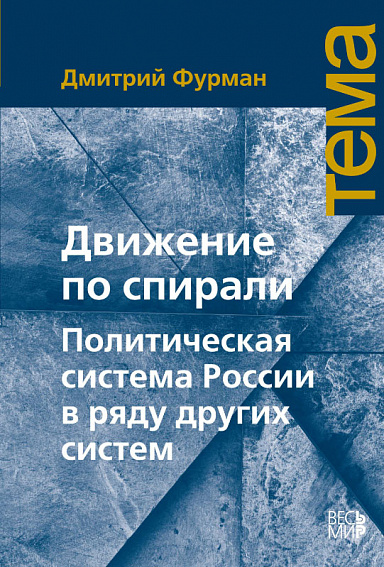
There are now a number of books on the political development of post-Soviet Russia, but Dmitry Furman’s work is worth reading for at least two reasons. First, this prominent Russian historian and political scientist provides a coherent outline of how Russia’s political system evolved without artificially detaching El´tsin’s era from Putin’s and explains why there was less room for democratic development in Russia from the outset (e.g. compared to Ukraine). Secondly, this is the perspective of a scholar who, since the early 1990s, has undertaken comparative research into post-Soviet regimes until his untimely death in 2011, and is renowned for his accurate prognoses on the political situation in the region. This, his last book, provides a particular overview of his concept which applies absolutely to the present situation in Russia.
Furman is amongst those who reject the idea of Russia’s exceptionalism and believe that her development has been quite normal. His many convincing comparisons with other countries with similar regimes, especially the post- Soviet states, prove this point. Furman views Russia’s post-Soviet political development as a system that he calls ‘imitation democracy’, driven by the logic of creating ‘non-alternative’ presidential power and which is currently close to its final crisis. Another relevant methodological argument, rendered in the title, is that there are such important similarities between the development of the Russian and Soviet political systems that one might even talk about the country’s ‘movement in spiral’. This analytical approach determines the structure of the book, which is divided into four chapters, covering the four stages of the system’s development. Furman’s epilogue offers two possible ways out of the current crisis, and considers Russia’s prospects for democracy.
Furman argues that democracy in Russia was doomed as soon as those who positioned themselves as democrats, with Boris El´tsin as their leader, came to power. The most important parallel between 1917 and 1991 is that a strong minority with an effective leader obtained power undemocratically and therefore had no other option but to create a regime which guaranteed their rule in order that they not end up in prison. Furman’s explanation as to why the Russian democratic movement was weaker than in many other former Soviet republics supports this argument. It is hard to disagree with Furman’s opinion that the Russian democrats did not really have a chance to become a majority since their ideas contradicted national aspirations. This is the reason why, after signing the Belovezh Accords, El´tsin, on the one hand, finally obtained all the powers of Russia’s President, but on the other, along with his supporters, found that he began to be perceived as being part of a ‘gang’ by the opposition and many ordinary voters. This was not the case, for example, with Leonid Kravchuk, the Ukrainian leader, who drew legitimacy from the national cause and safely left his country’s political Olympus a few years later. This logic leads Furman to question the democratic narrative of the early 1990s. He points out that it was El´tsin’s opponents’ victory that might have opened a road to democracy in Russia. Whether one agrees or disagrees with this point, given, for example, the very diverse political forces on Parliament’s side in 1993, reflection on the meaning of these events is important, because they have become marginalized in public consciousness due, very much, to the prevailing and highly influential discourse that promotes Vladimir Putin as a saviour of Russia.
The unexpected protests during the December 2011 parliamentary elections made Russia’s future look, once again, open-ended, despite Putin’s subsequent triumphal re-election. Furman argues that even Putin’s second presidential term marked the ‘limit of the system’s growth’ in terms of control. This was then clearly personified by Dmitrii Medvedev, with his liberal rhetoric and inarticulate revival of the transitological scheme, compounded by the symbolism of connections with the Russian Empire and the Soviet Union. In fact, since that time, maintaining stability has been the President’s sole aim. Furman sees an equivalent to the regime’s impotency in Soviet zastoi (stagnation), however. He is sceptical about less painful scenarios of the system’s dismantling, such as a ‘revolution from above’, an elite split or a coloured revolution, which reminds us of the high price Russia paid for stability during the twentieth century. Furman’s epilogue opens up possibilities for democracy — in the next system.