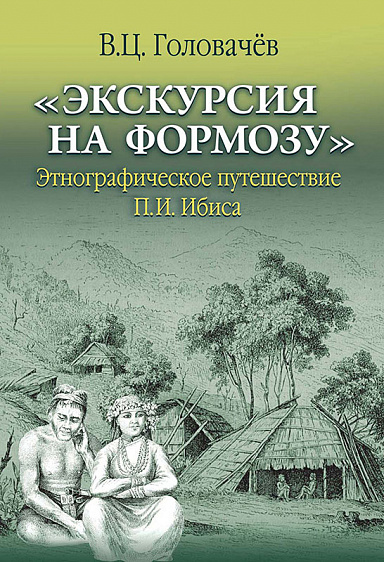
This book presents the life-story and ethnographic studies of Paul Ibis (1852– 1877), an ethnic Estonian and a citizen of the Russian Empire, an ensign of the naval navigator corps and a participant in circumnavigation on the sailing-screw corvette “Askold” in 1872–1876. In 1875, Ibis alone made a bold “ethnographic journey” to Taiwan. As a result, he wrote a detailed report and published it in two articles in the journals “Morskoy Sbornik” (1876) and “Globus” (1877). In total, he published five articles on Japan and Formosa in 1875–1877.
After the untimely death of Ibis in 1877, his name was lost and forgotten in Russia. It wasn’t until the early 1980s, when the Leningrad scholar M.F. Chigrinskiy recovered the name of the traveler, restored his biography and summarized the general content of his German-language article in “Globus”. Nowadays, the name of Paul Ibis is returned from oblivion in Russia, abroad and in Taiwan.
The long-term joint efforts of scholars and history buffs have allowed to restore the biography of Paul Ibis in much more holistic and accurate way, as well as created the ground for a deeper under standing of his scientific heritage and his real contribution to the Formosa’ ethnic and cultural studies. In many ways, this was facilitated by an expedition to Taiwan “following the footsteps” of Russian sailor by amateur travelers Fedor Labutin and Sergey Malkov from Chelyabinsk in 2014. The result of the expedition, which was widely covered in the media, was new research as well as a thematic exhibition held in six Russian cities (Miass, Chelyabinsk, Moscow, Sevastopol, Saint-Petersburg and Vladivostok) in 2014– 2018.
As it was proved by our comparative study, while Ibis was not the first person to carry out the ethnographic trip across Taiwan, his articles are in no way inferior to the general academic contribution of J.B. Steere, who visited Taiwan in 1873– 1874, and even surpass it in some aspects. The bold and profound conclusions based on the unique first-hand ethnographic materials, skillfully obtained by Ibis, as well as on advanced XIX c. theories and techniques, are of great scientific and cultural value even 140-plus years later, in the XXI century.
The life-story of Paul Ibis is inseparable from the entire history of circumnavigations by Russian Navy vessels in the XIX c. and from the numerous pioneering explorations made by the naval officers. His name is worthy of mention among the most famous «Military Orientalists» and other representatives of the domestic progressive intelligentsia who made an outstanding contribution to the studies of countries and peoples of the Orient, as well as to the peaceful expansion of international relations and the cultural influence of the “Russian world”.